


The Cable You Don’t Notice: Why That Might Be a Good Thing
You know that moment when a familiar song suddenly sounds different?
Not louder.
Not brighter.
Just more open.
You hear a small detail that you may have missed a hundred times before. The space around a vocal feels more natural. A bass note seems to arrive with greater definition. The music feels less like a collection of sounds coming from speakers and more like a performance happening in front of you.
For someone who loves music, those moments are what high-end audio is really about.
And this is where the humble speaker cable enters the story.
It’s Not Just About Connecting Two Boxes
Look behind an audio system and you’ll find an impressive collection of technology.
There is the amplifier.
There are the loudspeakers.
Perhaps a DAC, streamer, turntable, or other carefully selected source component.
And then there are the cables.
They don’t have displays. They don’t have buttons. They don’t produce music on their own.
Their job is much simpler.
Carry the signal from one component to another as effectively as possible.
But that seemingly simple job becomes more interesting when you consider what is actually happening inside the cable.
The electrical signal leaving an amplifier isn’t static. It is constantly changing with the music.
And whenever current flows through a conductor, electromagnetic fields are created around it.
That is where an important characteristic called inductance comes into play.
The Invisible Resistance to Change
Inductance can be thought of as the tendency of a conductor to oppose changes in current.
And music is nothing but change.
A drum hit rises and falls. A guitar string vibrates. A singer moves from one note to another. The electrical signal representing those sounds is constantly changing as it travels from the amplifier toward the loudspeaker.
The cable therefore isn’t simply carrying a fixed amount of electricity.
It is carrying a complex, constantly changing musical signal.
Reducing unnecessary inductance can help minimize the opposing effect created by the cable itself.
For a designer working on high-end speaker cables, that makes low inductance an important engineering consideration.
This Is Where the GSC 36 Gets Interesting
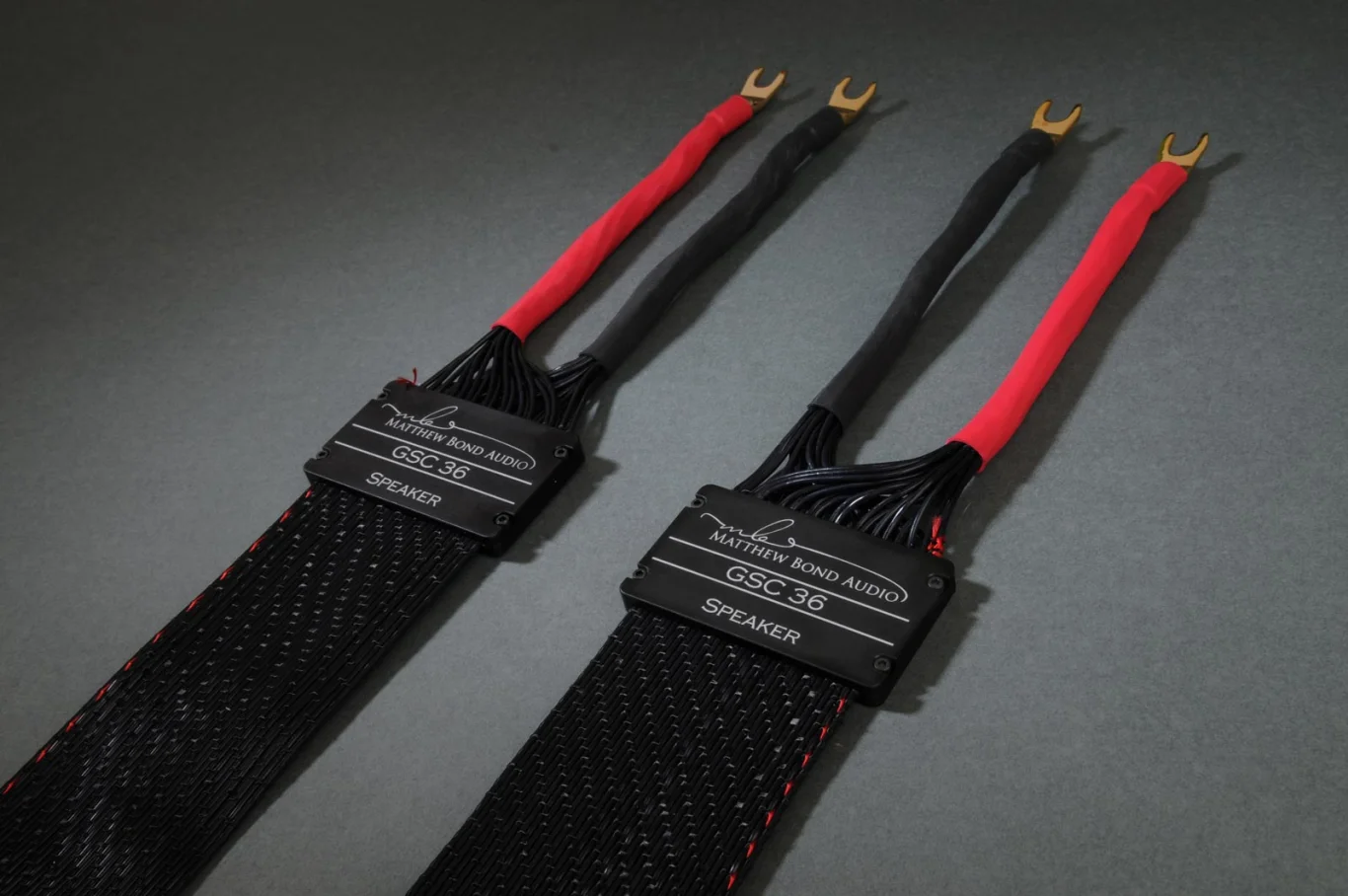
The Matthew Bond Audio GSC 36 Speaker Cable was designed with this principle in mind.
Its measured inductance is an exceptionally low:
0.024 micro-Henry per foot
That number may not mean much at first glance.
But behind that small number is a very deliberate design philosophy.
Rather than treating a speaker cable as simply a conductor with an attractive exterior, the GSC 36 is designed around the electrical behavior of the signal travelling through it.
The objective is simple:
Keep inductance low and provide the amplifier with an appropriately engineered path to the loudspeaker.
Why Would an Audiophile Care?
Because when you have spent thousands of dollars—or years—building an audio system, you don’t want the connection between your amplifier and loudspeakers to be an afterthought.
You want the components to work together.
You want the character of the recording to come through.
You want the system to respond to the music rather than make you think about the equipment.
That’s an important distinction.
The goal of a well-designed cable isn’t to become the star of the system.
In many ways, the ideal cable should simply get out of the way.
Beyond the Number
Of course, inductance isn’t the only characteristic that matters.
A speaker cable is a complete design.
The conductor, geometry, insulation, termination, connectors, mechanical construction, and overall electrical characteristics all work together.
This is why comparing cables based on one specification alone doesn’t tell the whole story.
The interesting part of the GSC 36 is that its low-inductance specification reflects a broader engineering approach.
The cable has been designed by considering what is happening to the signal—not simply what the cable looks like from the outside.
A Different Way to Think About High-End Cables
Walk into a showroom and you can find speaker cables in almost every shape, size, and price range.
Some are designed to make a visual statement.
Others emphasize exotic materials or elaborate construction.
But for the serious music enthusiast, perhaps the more interesting question is:
What is actually happening to the signal inside the cable?
That question leads somewhere much more useful.
It takes the conversation away from appearance and toward engineering.
It makes you think about resistance.
It makes you think about capacitance.
It makes you think about inductance.
And it makes you think about how the cable interacts with the amplifier and loudspeaker as part of one complete system.
When Engineering Becomes Part of the Listening Experience
You may never look at your speaker cables the same way again.
Because underneath that outer jacket, there is an electrical system responding to every note your amplifier sends toward the loudspeaker.
Every bass line.
Every cymbal strike.
Every vocal.
Every change in dynamics.
The signal is constantly moving and changing.
The job of the cable is to provide a carefully considered path for that signal.
That is the thinking behind the Matthew Bond Audio GSC 36.
With an exceptionally low inductance of 0.024 micro-Henry per foot, it represents a design approach focused on controlling the electrical characteristics of the cable rather than simply making another speaker wire.
And perhaps that’s what makes a high-end cable interesting.
Not that you notice the cable.
But that you can forget about the cable and concentrate on what you bought the entire system for in the first place:
the music.