Matthew Bond Audio GSC 18 amplifier cables
Matthew Bond Audio gold-plated cable connectors
Matthew Bond Audio Analog Reference Interconnect cable connectors closeup
Matthew Bond Audio GSC 36 amplifier cable closeup

PRODUCTS

high end speaker wire

Audiophile Speaker Cables: Why 99.9999% Pure Copper Matters

Summary: Discover why 99.9999% pure copper matters in audiophile speaker cables, from conductivity and low inductance to conductor geometry and dielectric materials, plus how these factors shape high-end speaker wire design.

What makes one piece of copper different from another?

At first, the question sounds almost too simple.

Copper is copper, right?

But spend enough time around serious audio equipment and you begin to notice that the conversation becomes much more specific. Conductivity, purity, conductor geometry, insulation, gauge, and electrical characteristics all start to matter.

For an audiophile, that level of detail is not about making a cable sound impressive on paper.

It is about understanding what happens to a musical signal while it travels from an amplifier to a loudspeaker.

And that is where 99.9999% pure copper becomes interesting.

Purity Is More Than a Number

When Matthew Bond Audio uses 99.9999% pure copper, often described as six-nines copper, the specification tells you something important about the conductor material.

There are very few impurities present.

That matters because the conductor is the pathway through which the electrical signal travels.

Think about a singer holding a note.

The amplifier converts that musical information into an electrical signal, and the speaker cable carries that changing signal toward the loudspeaker.

The conductor is part of that journey.

For designers of audiophile speaker cables, the goal is not simply to find a material that conducts electricity. It is to carefully consider how the conductor behaves electrically as part of the entire cable design.

Why Does Copper Purity Matter to Audio?

A high-purity conductor provides a very controlled material foundation for cable construction.

But there is an important point here.

Purity alone does not make a great audio cable.

The conductor has to work with the rest of the design.

That includes:

  • Conductor size and geometry
  • Insulation or dielectric material
  • Inductance and capacitance
  • Mechanical construction
  • The relationship between amplifier and loudspeaker

This is why high end speaker cables cannot be judged by material specifications alone.

A cable is a complete electrical design.

The Conductor Is Only Part of the Story

Imagine buying a beautiful instrument and then focusing only on the wood.

The material matters, certainly.

But the shape, construction, dimensions, setup, and countless small details also influence how the instrument behaves.

Cable design is not identical, of course, but the comparison helps explain the thinking.

Matthew Bond Audio has spent decades investigating conductors, gauges, insulation materials, and cable geometry.

That long history has led to a design philosophy where material selection is considered alongside measurable electrical characteristics and listening experience.

The result is not simply high purity copper placed inside a jacket.

It is a carefully engineered cable system.

Where Six-Nines Copper Meets the Listening Experience

This is where the technical discussion becomes more interesting for the person sitting in front of the speakers.

You may not think about copper when a piano note begins.

You hear the attack of the note.

You hear its body.

You hear the decay as it disappears into the recording.

The same applies to a vocal, a guitar, a string section, or a powerful bass passage.

High quality speaker cables are expected to provide a carefully engineered electrical path between the amplifier and loudspeaker, allowing the system to reproduce the signal without making the cable itself the center of attention.

That philosophy is particularly important in a high-resolution system.

When the rest of the equipment can reveal subtle information, every part of the signal path deserves consideration.

What About the Insulation?

Here is something that can easily get overlooked.

The conductor is not floating in empty space.

It is surrounded by an insulating material, and that material has electrical properties of its own.

Matthew Bond Audio uses polyester-mica insulation in its Insight and Intrigue cable designs.

Why does that matter?

Because the dielectric becomes part of the electrical behavior of the cable.

Matthew Bond’s research has focused not only on different conductor materials and gauges, but also on how insulation materials interact with electrical energy.

That is one reason the discussion around high end speaker wire goes far beyond simply asking how much copper is inside.

A Cable Has an Electrical Personality

Every cable has electrical characteristics.

Some are more inductive.

Some have higher capacitance.

The geometry of the conductors affects these properties.

And these characteristics can influence how a cable interacts with the equipment connected to it.

For speaker cables, inductance is especially important.

Keeping conductors appropriately arranged can help reduce inductance and support the rapid changes present in a musical signal.

This is one of the principles behind Matthew Bond Audio’s approach to cable geometry.

The objective is not to add a dramatic sonic effect.

It is to engineer the cable so its electrical behavior is carefully controlled.

So, Is 99.9999% Copper Worth Caring About?

For someone choosing ordinary wire for a basic audio setup, this level of purity may seem excessive.

For an audiophile building a carefully matched system, the question is different.

When an amplifier, DAC, source, and loudspeaker have all been selected with attention to detail, the cable becomes another part of the system that can be examined from an engineering perspective.

That does not mean purity is a magic number.

It means the material provides a precise starting point for a cable designer.

And when that conductor is combined with carefully considered geometry and dielectric materials, the entire design becomes much more interesting.

From Material to Music

This is perhaps the easiest way to understand the philosophy behind audiophile speaker cables.

The point is not to sit in front of the system thinking about copper.

The point is to listen.

To hear the texture of a recording.

To notice the space around a vocal.

To follow the decay of a cymbal.

To recognize small changes in dynamics.

To become absorbed in the performance rather than the equipment.

That is why 99.9999% pure copper matters at Matthew Bond Audio.

Not because six-nines purity is a magical promise of better sound.

But because serious cable design begins with taking every part of the signal path seriously.

And sometimes, the most important engineering decisions are the ones you stop noticing once the music begins.

FAQs

1. What is 99.9999% pure copper in speaker cables?

99.9999% pure copper, also called 6N copper, is highly pure copper used to create a clean and carefully controlled path for audio signals.

2. Why do audiophiles prefer pure copper speaker cables?

Audiophiles choose pure copper because copper conducts electricity very well and provides a refined material for carefully designed audio cable construction.

3. Does 99.9999% pure copper improve speaker sound?

Pure copper alone does not guarantee better sound. Cable design, conductor size, geometry, resistance, inductance, capacitance, and insulation also affect performance.

4. What should I look for in high end speaker cables?

Look at conductor purity, cable geometry, resistance, inductance, capacitance, insulation, conductor size, and how well the cable matches your amplifier and speakers.

5. Are high quality speaker cables only about copper purity?

No. Copper purity is important, but a high quality speaker cable also needs thoughtful design, suitable insulation, controlled electrical properties, and proper conductor arrangement.
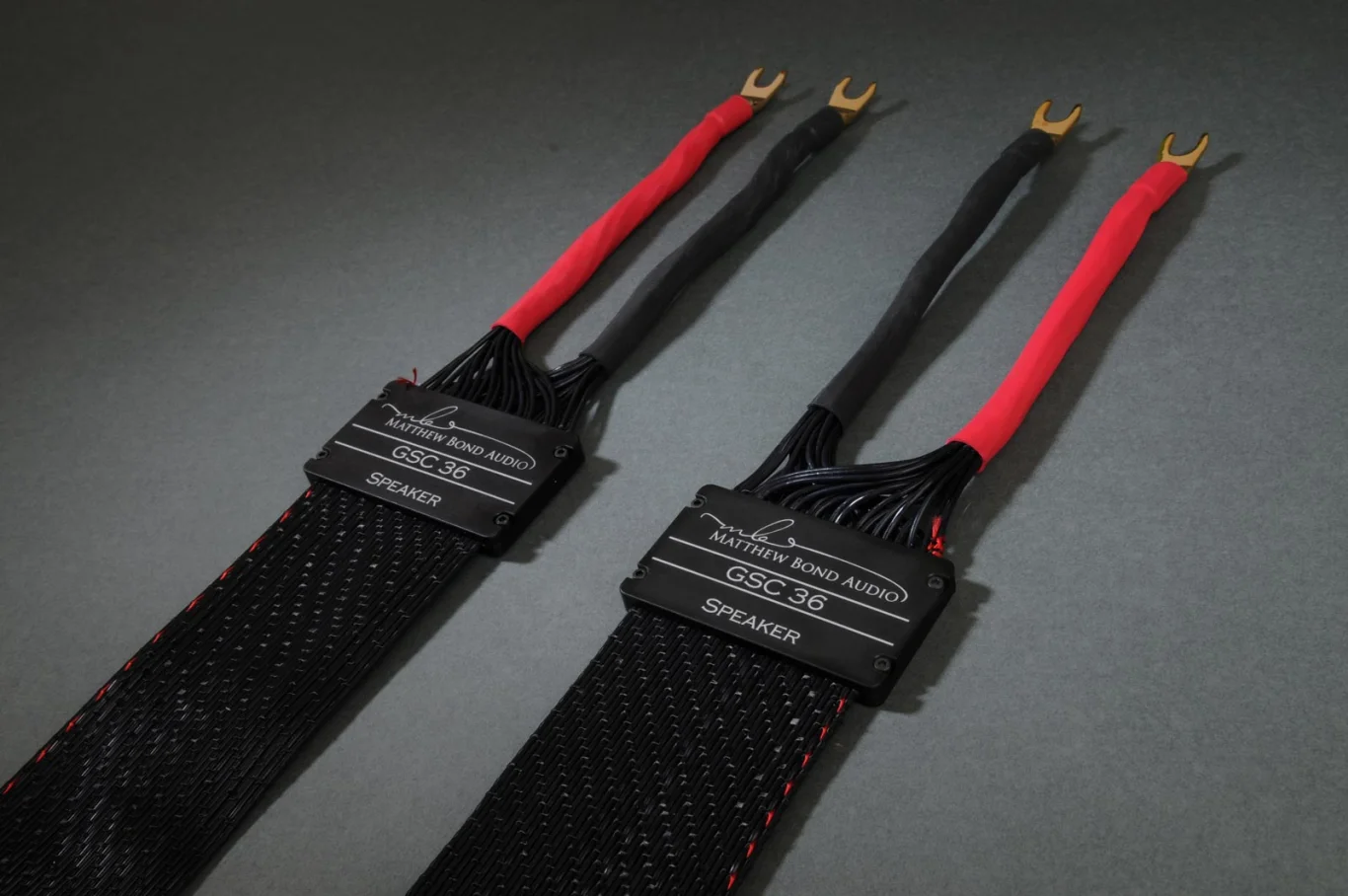
GSC 36 Speaker Cable

The Cable You Don’t Notice: Why That Might Be a Good Thing

You know that moment when a familiar song suddenly sounds different?

Not louder.

Not brighter.

Just more open.

You hear a small detail that you may have missed a hundred times before. The space around a vocal feels more natural. A bass note seems to arrive with greater definition. The music feels less like a collection of sounds coming from speakers and more like a performance happening in front of you.

For someone who loves music, those moments are what high-end audio is really about.

And this is where the humble speaker cable enters the story.

It’s Not Just About Connecting Two Boxes

Look behind an audio system and you’ll find an impressive collection of technology.

There is the amplifier.

There are the loudspeakers.

Perhaps a DAC, streamer, turntable, or other carefully selected source component.

And then there are the cables.

They don’t have displays. They don’t have buttons. They don’t produce music on their own.

Their job is much simpler.

Carry the signal from one component to another as effectively as possible.

But that seemingly simple job becomes more interesting when you consider what is actually happening inside the cable.

The electrical signal leaving an amplifier isn’t static. It is constantly changing with the music.

And whenever current flows through a conductor, electromagnetic fields are created around it.

That is where an important characteristic called inductance comes into play.

The Invisible Resistance to Change

Inductance can be thought of as the tendency of a conductor to oppose changes in current.

And music is nothing but change.

A drum hit rises and falls. A guitar string vibrates. A singer moves from one note to another. The electrical signal representing those sounds is constantly changing as it travels from the amplifier toward the loudspeaker.

The cable therefore isn’t simply carrying a fixed amount of electricity.

It is carrying a complex, constantly changing musical signal.

Reducing unnecessary inductance can help minimize the opposing effect created by the cable itself.

For a designer working on high-end speaker cables, that makes low inductance an important engineering consideration.

This Is Where the GSC 36 Gets Interesting

The Matthew Bond Audio GSC 36 Speaker Cable was designed with this principle in mind.

Its measured inductance is an exceptionally low:

0.024 micro-Henry per foot

That number may not mean much at first glance.

But behind that small number is a very deliberate design philosophy.

Rather than treating a speaker cable as simply a conductor with an attractive exterior, the GSC 36 is designed around the electrical behavior of the signal travelling through it.

The objective is simple:

Keep inductance low and provide the amplifier with an appropriately engineered path to the loudspeaker.

Why Would an Audiophile Care?

Because when you have spent thousands of dollars—or years—building an audio system, you don’t want the connection between your amplifier and loudspeakers to be an afterthought.

You want the components to work together.

You want the character of the recording to come through.

You want the system to respond to the music rather than make you think about the equipment.

That’s an important distinction.

The goal of a well-designed cable isn’t to become the star of the system.

In many ways, the ideal cable should simply get out of the way.

Beyond the Number

Of course, inductance isn’t the only characteristic that matters.

A speaker cable is a complete design.

The conductor, geometry, insulation, termination, connectors, mechanical construction, and overall electrical characteristics all work together.

This is why comparing cables based on one specification alone doesn’t tell the whole story.

The interesting part of the GSC 36 is that its low-inductance specification reflects a broader engineering approach.

The cable has been designed by considering what is happening to the signal—not simply what the cable looks like from the outside.

A Different Way to Think About High-End Cables

Walk into a showroom and you can find speaker cables in almost every shape, size, and price range.

Some are designed to make a visual statement.

Others emphasize exotic materials or elaborate construction.

But for the serious music enthusiast, perhaps the more interesting question is:

What is actually happening to the signal inside the cable?

That question leads somewhere much more useful.

It takes the conversation away from appearance and toward engineering.

It makes you think about resistance.

It makes you think about capacitance.

It makes you think about inductance.

And it makes you think about how the cable interacts with the amplifier and loudspeaker as part of one complete system.

When Engineering Becomes Part of the Listening Experience

You may never look at your speaker cables the same way again.

Because underneath that outer jacket, there is an electrical system responding to every note your amplifier sends toward the loudspeaker.

Every bass line.

Every cymbal strike.

Every vocal.

Every change in dynamics.

The signal is constantly moving and changing.

The job of the cable is to provide a carefully considered path for that signal.

That is the thinking behind the Matthew Bond Audio GSC 36.

With an exceptionally low inductance of 0.024 micro-Henry per foot, it represents a design approach focused on controlling the electrical characteristics of the cable rather than simply making another speaker wire.

And perhaps that’s what makes a high-end cable interesting.

Not that you notice the cable.

But that you can forget about the cable and concentrate on what you bought the entire system for in the first place:

the music.


Matthew Bond Audio Insight Series Interconnect Cables

How Do Audio Cables for Music Enthusiasts Improve Sound Clarity and Detail

Matthew Bond Audio Insight Series Interconnect Cables

Summary: This blog explains how audio cables affect sound clarity and detail in music systems. It covers cable design, signal loss, interference, solid core conductors, and high-end audio performance, helping music lovers understand better listening quality and cable importance. 

When people talk about better sound, they usually think about speakers, amplifiers, or headphones. But there is one part of the system that quietly carries every detail you hear: the cable. 

For a music lover, this is not just a connector. It is the path that carries every note, every breath of a singer, and every small detail in the recording. If that path is not designed well, the sound can lose realism and clarity before it even reaches your speakers.

This is where carefully made audio cables can make a real difference. 

What Audio Cables Actually Do In A Sound System 

Audio cables carry electrical signals from one device to another. These signals represent music. Even small design issues in a cable can slightly change how those signals are transferred.. 

For someone who listens closely, even small changes matter. That is why high-quality designs like solid core conductors and low noise designs are used in premium systems. 

When people search for the best audio cables for a music enthusiast, they are usually looking for one thing: a more natural and detailed listening experience. 

How Cable Design Affects Sound Clarity And Detail 

  1. Less Signal Loss Means Clearer Sound 

A well-made cable helps the signal move without loss or distortion. When signal loss is low, you hear more of the original recording instead of a “soft” version of it. 

This is where advanced hi end speaker cables and interconnects are designed to maintain signal integrity across the full audio spectrum. 

  1. Lower Interference Brings More Detail 

Music has many small details like background instruments, echo, and room acoustics. If a cable picks up unwanted electrical noise, these details can get lost or distorted. 

High-quality designs focus on reducing unwanted noise so the sound stays clear, detailed and authentic. 

  1. Better Conductor Structure Improves Accuracy 

One of the most important design choices in premium cables is the conductor type. A solid core speaker cable or interconnect cable is often used because it gives a clear and noise free path for electrical signals. 

Unlike multi-strand designs, solid core construction keeps the signal quality clear, clean and accurate, especially in high-end systems where realism matters. 

  1. Materials That Support Natural Sound Flow 

Pure copper and high-quality insulation materials are used in advanced designs to support clean signal flow. These materials reduce unwanted energy loss and help keep a more natural tone. 

What Music Enthusiasts Actually Hear With Better Cables

When someone upgrades to a well-made cable system, the change is not about louder sound. It is about clearer sound. 

You may notice: 

  • Vocals feel more natural and less “flat” 
  • Instruments sound more separated instead of mixed together 
  • Background details become easier to hear 
  • The overall sound feels more open and real 

It is not about changing the music. It is about showing more of what is already there.

Why Design Thinking Matters, Not Just Materials 

Many people think better cables are only about costly materials. But design is even more important. 

In advanced engineering approaches, factors such as signal flow control, conductor spacing, and insulation behaviour are carefully studied. The goal is simple: let the music pass through as cleanly as possible. 

This is what separates normal cables from truly refined ones. 

Who Benefits The Most From High-End Audio Cables 

Not every system needs premium cables. But for certain listeners, they can make a clear difference. 

They are ideal for: 

  • People with high-quality home audio systems 
  • Listeners who enjoy detailed and immersive music playback 
  • Music lovers who care about sound accuracy 
  • Users upgrading from mid-range to high-end setups 

If you already have good speakers and an amplifier, cables become the next step in improving your sound. 

Common Misunderstanding About Audio Cables 

A common belief is that cables “create” better sound. That is not true. They do not add anything new. 

Instead, they protect what is already in the recording. Think of them as a clean window. A better window does not change the view, it simply lets you see it more clearly. 

Wrapping It Up:

At Matthew Bond Audio, we believe music should feel alive, natural, and full of detail. That is why every design choice we make focuses on clean signal flow, stability, and accuracy. 

Our approach at Matthew Bond Audio cable design is built on many years of engineering and listening experience. We focus on revealing the small details that often get lost in normal setups. 

If you are looking for the best audio cables for music enthusiasts or exploring upgrades like speaker cables for high end systems or a solid core interconnect cable, the goal is simple: hear more of your music, not less. 

If you are ready to experience sound with more depth and clarity, explore our range of cables and see how your system can perform when every detail is allowed to pass through without loss. Your music deserves that level of care, and we are here to provide it. 

 FAQs

1. Do audio cables really improve sound quality? 

Yes, good audio cables help carry sound signals more cleanly, reduce unwanted noise, and let you hear clearer music with better detail and separation of images.

2. What makes high-end speaker cables different? 

High-end speaker cables use better materials and better designs to reduce signal loss and noise, which helps music sound more natural, clear, and detailed.

3. What is a solid core speaker cable? 

A solid core speaker cable uses one solid wire instead of many strands, helping the signal stay stable and clear for more accurate and clean sound.

4. Why do music lovers care about audio cables? 

Music lovers care because better cables help reveal subtle details in the music, like soft instruments and vocals, the small dynamic contrasts called micro-dynamics, making the listening experience more real and enjoyable.

5. Do expensive audio cables change music sound? 

They do not change music, but help deliver the original sound more clearly, so you hear more details, less noise, and a better overall sound. 

CONDITIONAL LIFETIME WARRANTY

Matthew Bond Audio cables come with a conditional lifetime warranty. "Conditional" means that the cable has not been damaged or tampered with, and "lifetime" means that the cable is guaranteed to perform as new for the original owner.