Matthew Bond Audio GSC 18 amplifier cables
Matthew Bond Audio gold-plated cable connectors
Matthew Bond Audio Analog Reference Interconnect cable connectors closeup
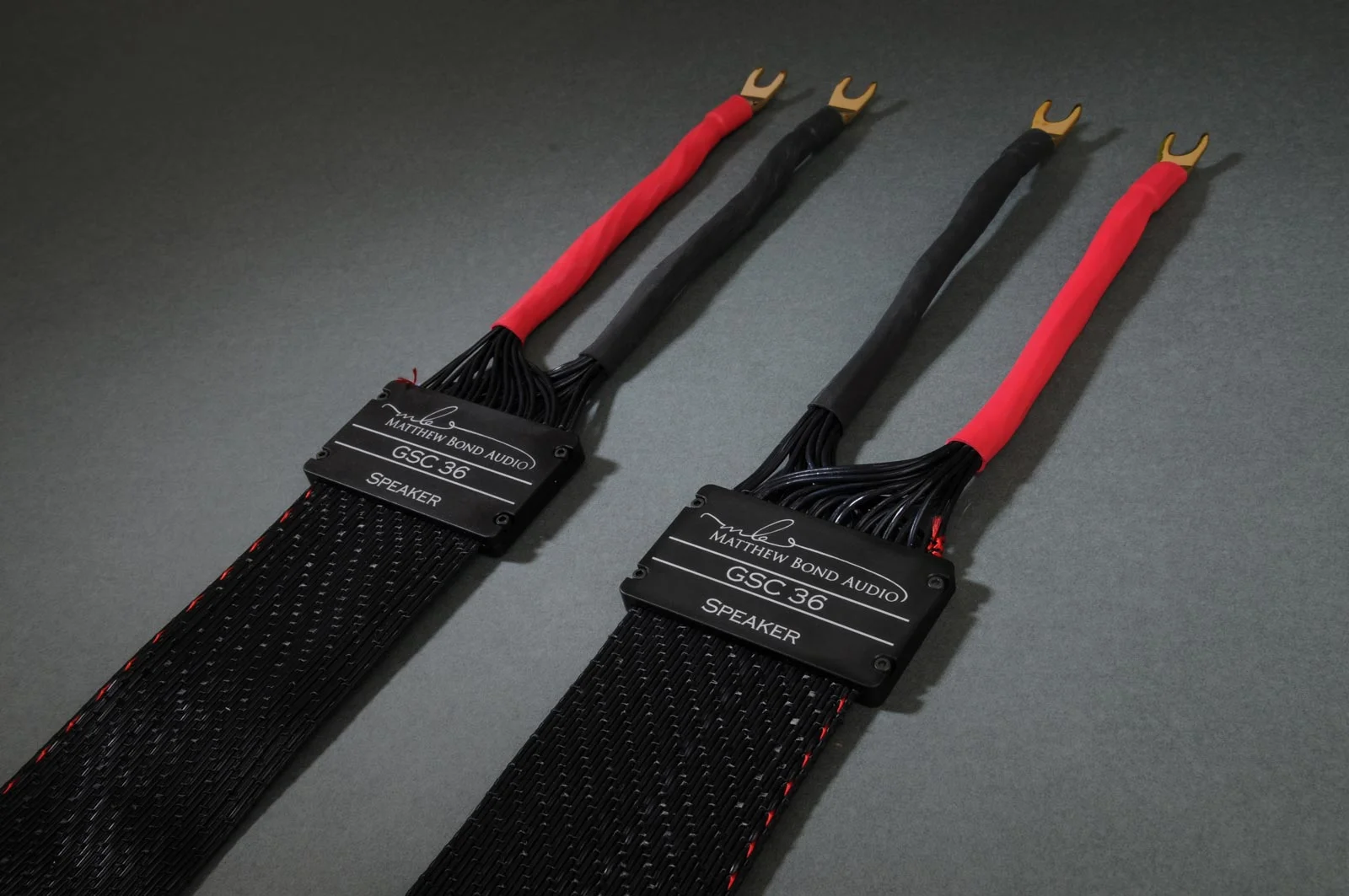
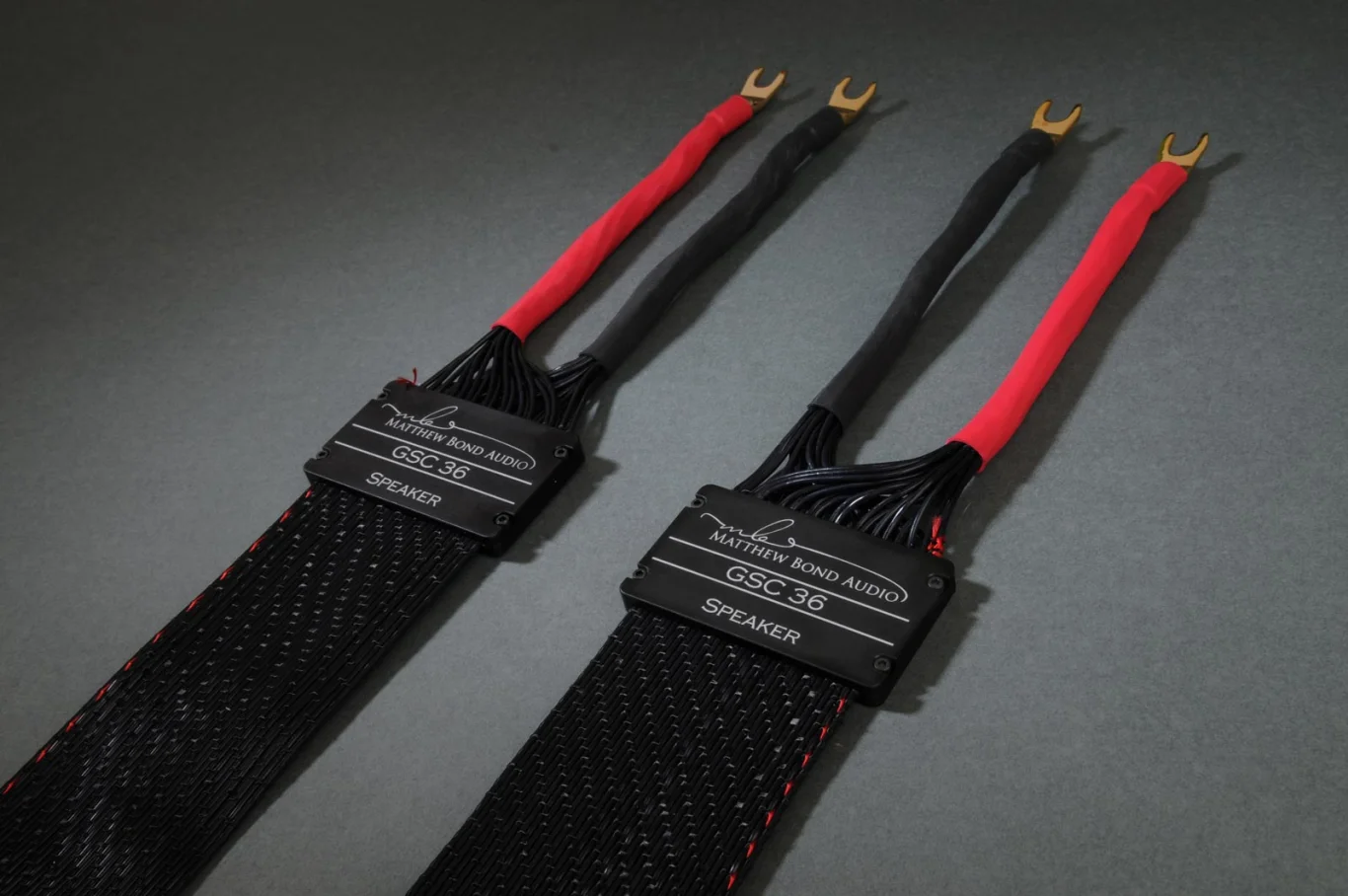
Matthew Bond Audio GSC 36 amplifier cable closeup

PRODUCTS

Matthew Bond Audio GSC 36 amplifier cable closeup
Matthew Bond Audio GSC 18 amplifier cables
Matthew Bond Audio gold-plated cable connectors
Matthew Bond Audio Analog Reference Interconnect cables closeup
Matthew Bond Audio

High-Quality Engineered Cables: The Science Behind a Better Audio Connection

When it comes to great audio, most people immediately think about the loudspeakers, amplifier,  microphone, or recording equipment. But there is one part of the signal chain that is often overlooked: the cable.

A cable may look simple on the outside, but its internal construction can have a significant  role in how faithfully and reliably an audio signal travels from one component to another. That is where  high-quality engineered cables make a difference.

At Matthew Bond Audio, cable design is approached as an engineering discipline—not  simply as a matter of appearance, marketing or branding.

The right combination of conductors,  insulation, shielding, geometry, and connectors creates a cable designed to deliver consistent performance.

It Starts With the Conductor

At the heart of every audio cable is the conductor.

Copper is widely used in audio applications because of its excellent electrical conductivity.  However, the quality of a cable is not determined by the conductor material alone. Its gauge, the geometry, purity, and construction all contribute to the cable’s electrical characteristics.

That is why properly engineered cables are designed around the application they are  intended to serve. A cable carrying an amplifier to speaker signal, for example, has different requirements from a cable carrying a line-level interconnect signal.

The Invisible Challenge: Interference

Your audio system doesn’t operate in isolation.

It shares its environment with the audio components, their power supplies, lighting systems, electrical devices, and countless other potential sources of electromagnetic interference(EMI) and radio-frequency interference(RFI).

For sensitive audio signals, unwanted interference can become a real concern. This is where shielding becomes important.

A well-designed shield acts as a barrier that helps reduce unwanted electromagnetic energy  from coupling into the signal path. Different cable constructions may use braided, foil, spiral,  or a combination of shielding depending on the intended application.

Good cable engineering isn’t simply about adding more shielding. It’s about using the right  shielding design.

Why Cable Geometry Matters

Inside a high-quality engineered cable, the arrangement of the conductors is not random.

The distance between conductors, their orientation and their size can influence electrical properties such as capacitance and inductance.

These characteristics are part of the cable’s overall electrical behavior.

Think of it as the architecture of the cable. Two cables may look almost similar from the  outside while having very different internal designs.

Careful control of cable geometry allows Matthew Bond Audio to create predictable and repeatable  electrical characteristics—an important consideration for high-end audio applications.

More Than Just Wires: The Role of the Dielectric

Surrounding the conductor is an insulating material known as the dielectric.

Its primary job is to keep electrical conductors separated, but its influence doesn’t stop  there. The dielectric’s electrical properties can affect the sound of the cable and  therefore its overall behavior within an audio system.

Materials, thickness, and construction all matter.

This is one of the reasons that designing a high-quality audio cable involves much more than  selecting a piece of conductive metal and putting an outer insulation over it.

A Strong Connection Requires Strong Terminations

Even the best-designed cable can be compromised by a poor connection.

Connectors are the interface between the cable and the equipment. Their construction,  contact quality, plating, strain relief, and termination all contribute to the sound quality of the connection.

A professionally engineered cable should therefore be considered as a complete system— from the conductor inside the cable to the connector at either end.


The Right Cable for the Right Application

There is no single cable that is ideal for every audio application.

An analog interconnect cable may prioritize low-noise transmission and effective shielding. A speaker cable may place greater emphasis on conductor size and current-handling capability. A line level interconnect may require a different balance of capacitance, shielding and conductor design.

The best approach is to choose a cable based on the requirements of the signal path, rather  than simply choosing the most expensive option.

When choosing an audio cable, consider:

• What type of signal will it carry?

• How long does the cable need to be?

• Will it be used in a studio, stage, installation, or home environment? • Is electromagnetic interference a concern?

• What electrical specifications are appropriate for the equipment?

These questions can lead to a much better cable selection than price or appearance alone.

Engineering You Can Hear—and Rely On

A great audio system is made up of many carefully selected components. Cables are a part of that system, and their job is to provide an emotional and audible improvement in your system.

High-quality engineered cables bring together materials science, electrical engineering,  precision manufacturing, and mechanical design to create transparent, neutral and revealing connections for high-end audio systems.

At Matthew Bond Audio, the focus is on thoughtful cable engineering and quality  construction—because the connection between your equipment deserves the same  attention to detail as the equipment itself.

Whether you’re creating a new audio system, upgrading an existing audio system, or simply looking for musically satisfying audio cables, choosing a properly engineered cable is a small decision that will contribute to an audibly realistic and lifelike audio experience.

Audio Cable Design Facts: Science vs. Audiophile Myths Exposed

The majority of audiophiles, reviewers, and audio cable manufacturers lack a basic understanding of how cables function and behave in an audio system. For over 47 years, I have listened to different conductors, wire gauges, and conductor materials, as well as the same conductors with various insulation and dielectric materials. In many cases, I have been able to use electrical measurements and testing systems to correlate these variables with the listening experience.

After 47 years of A/B testing and listening to conductors I have found that conductor purity is not the most important factor. The electrical conductivity of 6 Nines copper and 4 Nines copper (99.99% pure) is basically the same at room temperature. Even if conductor purity were to make a small difference, it is one that is easily ‘swamped’ or sonically overwhelmed by conductor size and conductor spacing.

Quite simply, a 17 AWG(1.15 mm diameter) copper conductor of Six Nines 6N 99.9999% purity has high frequency roll off when compared to an 18 AWG(1.02 mm diameter) 4 Nines 99.99% pure copper conductor. So, conductor purity along with conductor material technologies are something that should be regarded with skepticism. Note that the conductor purity of any metal conductor is ‘swamped’ or sonically overwhelmed by the increase in conductor gauge/diameter.

I am still using 1mm or smaller diameter pure copper conductors. In 1988 my simple solid core 99.99% pure Phase 2 speaker cable was Class A in Stereophile beating out Monster, Audioquest, MIT and 8 or so other speaker cables. In an industry with so much hyperbole I have remained silent, but as I get older I am tired of the hype, and the miraculous and fictional technologies. Cables make sonic differences to be sure, but the differences must in my opinion, render the sound more like live music. Clarity, transparency, detail etc. may be important. But, palpable images and instrumental outlines and a sound that replicates real voices and musical instruments must be the goal. Instead we have a whole lexicon devoted to the sound of cables and no clearly articulated description of what is perfect.

In the following I will use the analog interconnect cable as my example. The most important element in cable design is the size of the conductor(s). If the conductor is larger than 18 gauge, then the high frequencies will be rolled off, so we must choose a conductor that has frequency linearity; no more than 1mm or 18 gauge. After that, the geometry and spacing become important. If the conductors are too close, the Capacitance or electrostatic charge between the conductors will cause high frequency roll off. With the conductors spaced properly, the insulation materials and the dielectric between the conductors now become audible. The audio signal does not travel through the dielectric as easily as through the conductor. The conductor and its insulation likely act similarly to a capacitor, absorbing and releasing an electrical charge, distorting the audio signal. The worst polymer material for insulation/dielectric materials is PVC and the best is PTFE (Teflon).

And finally we have metallurgical treatments, with this I mean cryogenics, metal alloys and grouping of conductors made from different conductor materials. Many high-end cable companies are making nothing more than what I call cocktail cables… a mix of this and that, silver with gold conductors or a variety of metals and the cables simply sound different as if that were the goal of cable design. I see this as misdirection, hype and storytelling.

The right cables can make a big difference in high quality audio systems. A correctly designed cable will contribute to a spacious soundstage with properly outlined images of recorded performers within the soundstage. Words like clarity, neutrality, transparency etc. are misleading, even unimportant. Instead you should listen for your system to reveal a compelling reproduction of the live musical event. That’s the true goal of being an audiophile; putting together a system that has you thinking that you are there, that the vocals and instruments sound real, natural and lifelike.

I could nominate many audio cable companies for the Uri Geller cable award, but I’ll name just a few. First from the envelope, is a cable from Purist Audio Design with clear PVC plastic tubes filled with water. Insulated copper conductors are loosely held inside the water dielectric. If you hold the tube just right the air bubble reveals the AWM conductor marking on the conductor’s PVC insulation. A Home Depot and faucet miracle.

Another nominee is a cable company claiming the use of antique copper. High frequency sheen? A fine patina in the mid-range? Luster in the bass? Maybe the sound just has a nice tone.

Then there are Synergistic Research cables with devices suspended around the cables. The suspended devices are intended to fine tune the sound and the designer claims that the devices are not in the signal path. If the devices around the cable are not in the signal path Ted, then how do the devices make a sonic difference? More magic? No, the electromagnetic wave, the signal path, is within and around the conductors in the cables. That’s why the devices work. That’s why insulation materials on the conductors matter.

My personal favorite is VDH who showed off his Liquid Nitrogen cooled speaker cables, claiming that the resistance in the cable was zero. How cool, right? I’ve left the best for last… he also claimed that the inductance was zero. I tried to clear up his claim but he wouldn’t listen to me. Really, what do I know? Can the inductance be reduced in a super cooled cable? Will some of you figure it out?

Inductance… I’ll start with an example, an inductor first, which is a simple coil of wire found in the crossover of a loudspeaker. The inductor is used to roll off high frequencies and as the coil gets bigger and longer the inductance of the coil rolls off more and more high frequencies along with mid-range frequencies. The inductance of the coil does not change with temperature. When I tried to explain this using inductors as an example, VDH told me that there were no inductors in his invention which he proposed to sell for $250,000. I didn’t have my checkbook with me at the time.

Inductance and the speaker cable…

The electrical current or signal flowing in the conductor from the amplifier is a constantly changing, complex set of electromagnetic waves that travel through and around the conductor. An external magnetic field is created that induces a current that flows in the opposite direction in the conductor. So, when a signal current is flowing in a wire, a force is created that opposes that signal. This force, the opposing current, impedes the flow of the wanted signal current. The force is known as electromotive force. In a speaker cable, it is important to make the inductance as low as possible to reduce the electromotive force. Finally, the Inductance in a speaker cable is not affected or reduced by temperature.

Not An Audiophile podcast

Not An Audiophile Podcast: Matthew Bond, TARA Labs & Matthew Bond Audio

An exclusive podcast with Matthew Bond, founder of Matthew Bond Audio.

Matthew Bond goes deep inside the intricacies, design, engineering and manufacture of high quality cables. From the inception of TARA Labs and the cables that took the world by storm to the new Matthew Bond Audio and his revolutionary new designs.

Listen to the podcast now on the Not An Audiophile website or choose from the audio links below:

Listen on Apple Podcasts Listen on YouTube Music Listen on Spotify Podcasts

Not An Audiophile podcast

Not An Audiophile Podcast: HiFi Cable Guru debunks cable myths with Matthew Bond

Delve into the intricacies of HiFi cable technology, construction, the impact of materials and the science behind high quality cables. The conversation takes a real turn into debunking cable myths including burn-in processes and poor sound from thick plastic cable coatings. Andrew Hutchison believes that cable lifters are the “stupidest” piece of HiFi bullsh**t” but Matthew Bond and Brad Serhan have some theories and science that may disagree. Claims of different cables having different “timing” and cryogenic treatments.

Continue reading

CONDITIONAL LIFETIME WARRANTY

Matthew Bond Audio cables come with a conditional lifetime warranty. "Conditional" means that the cable has not been damaged or tampered with, and "lifetime" means that the cable is guaranteed to perform as new for the original owner.
five star review

… I heard a clarity, neutrality, and lack of harshness in any well recorded music that I’ve never heard before with any cable. The GSC-36 improved the sound to almost live. All instruments whether in Jazz, Classical, or Rock recordings were correct in relative volume, tone, detail, position in sound stage (lateral and depth), and […]

five star review

You must know that your cables are really something special. I have never heard such an improvement in my system that rivals the improvement from your cables. I have experienced differences when I upgraded my dcs stack of components, but I have never heard such an improvement as I have with the Matthew Bond Audio […]

five star review

The most remarkable virtue of the Analog Reference interconnect is its ability to add density to images, to vocals, to the music overall. How does a wire do this? I have not been aware previously that the images of sound have been almost skeletal relative to how they now sound. This makes music sound so […]

five star review

… I do not believe that any component I have upgraded has made such a significant improvement in the sound quality of my system … virtually every aspect of sound has been improved, the entire frequency spectrum, micro and macro dynamics, imaging, etc. But what makes these cables so unique (and it is a first […]